

Quickly and freely calculate the carbon footprint of your events using our online simulator. Obtain an accurate estimate of emissions for your tenders and CSRD compliance.


Taking action means measuring, and measuring your carbon footprint is time-consuming.
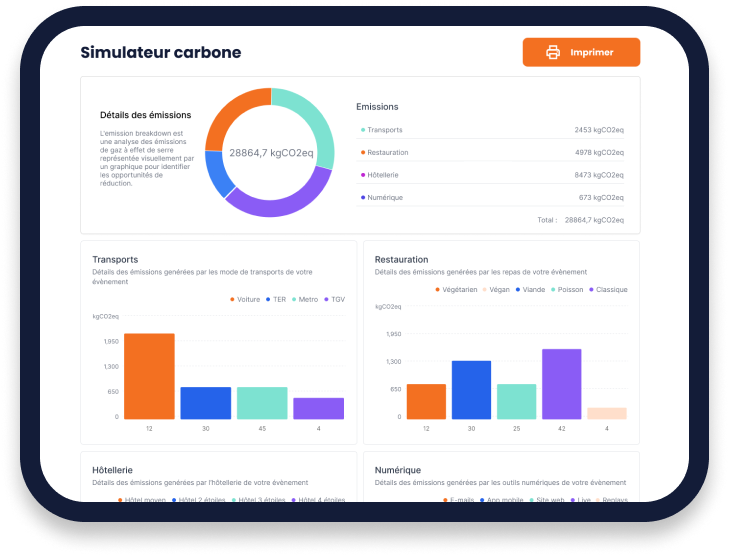
AppCraft (the first French Event Tech company to be ISO 20121 certified since 2021) offers a simple, fast, and free solution to help brands meet CSR requirements. CSR requirements and, in the future, CSRD requirements. More than just a CO₂ calculator, our solution breaks down each source of emissions (transport, accommodation, catering, digital) and provides you with concrete suggestions for improvement. You thus benefit from a tool that is both strategic and operational for designing truly responsible events and exporting your data to third-party tools.
• Automatically retrieve 90% of the information
◦ From the invitation form , ask your guests about their means of transportation
• AppCraft offers ready-to-use fields to calculate the CO2 impact of travel
◦ For information, this is the biggest impact factor on an event
◦ AppCraft automatically calculates your travel
• From The invitation offer several types of menus (meat, vegan, etc.)
• Integrate your hotels' CO² data
• Complete the other CO² consumption items
• AppCraft automatically calculates your CO₂ consumption based on ADEME data.
• At AppCraft, we have been calculating our carbon footprint since XXX and are ISO20121 certified.
• Offering you a free assessment of the carbon impact of your event(s) is part of our CSR approach.
• The economic aspect should not be a barrier to measuring the impact of our events on the planet
• Everything you need to take action is included; you don't need to purchase another carbon footprint assessment tool or CO2 calculator.
• Edit your form with the "carbon footprint" fields
• Let your participants enter their mode(s) of transport
• View your impact in real time
• Edit a complete report
• Export your XLS data to your global tool for your company's carbon footprint
• Optimize your impact at your next events
• Use our new eco-friendly modules and features, such as our
◦ carbon simulator
◦ carbon impact calculator for modes of transportation used;
◦ carpooling module;
◦ paperless mobile app.
• Integrate hybrid and digital solutions to both expand your audience and reduce your carbon footprint, while giving participants the freedom to choose whether or not to travel.
And in general: we are here to help you align your CSR objectives with the organization of high-impact corporate events!
Choose our ISO 20121-certified solution
• In just 3 minutes, get a complete estimate of your event's carbon footprint.
• Boost your credibility in tenders by demonstrating your environmental commitment.
• Break down all sources of emissions: transportation, catering, hotels, digital.
• Download or print a complete report, ready for your presentations and meetings.
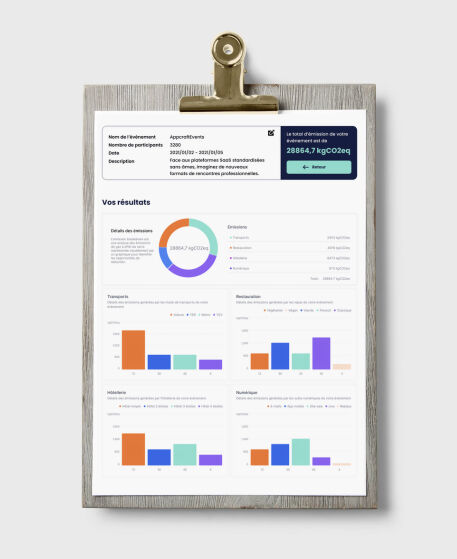
Calculate the carbon footprint of your event allows you to measure, understand, and reduce the environmental impact of each action related to your organization: transportation, accommodation, catering, digital technology, equipment, etc.
In concrete terms, this assessment helps you:
• Identify the areas with the highest CO₂ emissions (often transportation and logistics).
• Implement concrete solutions to reduce your emissions (shuttles, vegetarian menus, sustainable accommodation, etc.).
• Raise awareness among your teams and service providers to environmental issues.
• Strengthen the credibility of your CSR approach, particularly in the context of calls for tenders or future obligations under the CSRD.
We simplify this process for you with a integrated, fast, and free carbon solution, which provides you with clear analysis and personalized areas for improvement to design truly responsible events.
Calculate the carbon footprint of a seminar or professional event is a quick and easy process thanks to the integrated AppCraft solution. Here are the main steps:
1. Enter the key information about your event (number of participants, location, duration, accommodation, catering, transportation, etc.).
2. Automatically collect carbon data via registration forms (mode of transportation, type of meal, choice of hotels, etc.).
3. Instantly analyze the emissions generated by each item using our tool connected to official ADEME data.
4. Identify the most significant sources of emissions and discover concrete alternatives: carpooling, group shuttles, low-carbon menus, digitization of materials, etc.
5. Download or share your detailed carbon report, ideal for your internal presentations or CSR reports.
To get the most out of an event carbon footprint module, it is important to avoid certain common mistakes. The first is to view the carbon footprint as a mere formality or a document to be produced after the event. To be truly useful, it must be integrated from the event preparation phase onwards, so that it can influence logistical and organizational choices.
Another common pitfall is collecting incomplete or inaccurate data. Imprecise information about modes of transportation, accommodation, or catering can skew the analysis and limit the relevance of recommendations. It is therefore essential to raise awareness among participants and service providers about the importance of providing reliable data, while keeping forms simple so as not to discourage participation.
It is also inadvisable to focus solely on the overall emissions figure without analyzing the breakdown by category. The value of the AppCraft carbon module lies in its ability to identify the main levers for action. Without this detailed analysis, it becomes difficult to implement concrete and measurable improvements.
Finally, it is important not to isolate your carbon footprint assessment from the rest of your CSR approach. The results must be shared, explained, and used as a tool for raising awareness and driving continuous progress, both internally and with your partners. It is this comprehensive approach that enables you to transform your carbon footprint assessment into a real lever of credibility and impact for your events.
Several tools are available on the market, such as Beevent (on which we are listed), Carbo Event, Cleo Carbone (for UNIMEV members) or Cleo Impact, Climate Seed, Climeet by Green Evénement, GCI, GLIMPACT, Good Planet, and Greenly (on which AppCraft is also listed)
So there are many solutions, some very simple like GoodPlanet, others very complex like Cleo, CGI, or GLimpact.
All these tools require tedious, even very tedious data entry, which can make their adoption or regular use discouraging.
AppCraft's goal is precisely to facilitate the collection of participant-related data, which is essential because transportation, accommodation, and catering account for 80% of the carbon footprint.
So we don't measure everything, but we measure the essentials to enable event organizers to start measuring and commit to a reduction process.
We also take an open approach, so that the data we collect automatically can be exported to the solutions mentioned above.
"Given the complexity and diversity of the data potentially involved in this calculation, the sector must identify the items that are both the most significant in terms of carbon footprint and the most easily measurable and actionable.
Conversely, it must disregard data that is easy to collect or considered particularly relevant for impact measurement, but whose weight in the total carbon footprint would be negligible. In other words, let's not waste time reducing your carbon emissions by 50% when they represent 1% of your Carbon Footprint®, but rather seek to reduce your emissions by 20% when they represent 75% of your Carbon Footprint®.
Initiated in April 2021 and ratified in December 2022, a new European directive, known as the CSRD (Corporate Sustainability Reporting Directive), aims to fundamentally change the way European companies communicate their sustainability commitments.
The objective of this new standard is twofold:
encourage greater transparency among a larger number of companies on these sustainable commitment issues, and harmonize this reporting to make it easier to read.
Approximately 50,000 companies will be affected by these new reporting requirements, starting on January 1, 2025, according to a phased schedule:
• Non-European companies with more than €150 million in revenue in Europe,
• Companies listed on European markets, regardless of their size,
• Unlisted companies exceeding at least two of the following three thresholds: 250 employees / €40 million in revenue / €20 million in assets. This new reporting requirement should make it possible to determine the impact of environmental issues on the company's activities, as well as the impact of those activities on the environment and people.The first financial year covered by this new directive is 2024, for companies already subject to reporting requirements.
Other large companies will have to report on their 2025 financial year, and listed SMEs on their 2026 financial year.
The assessment of carbon emissions will be included in this reporting.