According to ADEME, an average event with 5,000 attendees generates 2.5 tons of waste and consumes 1,000 kWh of energy. Event management accounts for a significant portion of companies’ carbon footprints, which often goes unnoticed in overall reports because it is spread across dozens of stakeholders. Organizing an eco-responsible event is no longer optional: it is a strategic, regulatory, and reputational imperative. This guide provides an operational checklist, insights into brand challenges, and essential warnings to avoid event greenwashing.
Environmental responsibility in event planning is not limited to a few visible eco-friendly actions. It covers the entire event lifecycle: eco-design in the planning phase (choice of venue, format, and vendors), managing the environmental footprint during the event (energy, catering, waste, and transportation), and measuring the impact afterward. It also incorporates social dimensions: accessibility, local integration, and vendors’ working conditions.
The first concrete step is a preliminary environmental assessment: identifying the areas with the greatest impact before determining priority actions. Without this assessment, energy and budget are invested in secondary factors while the most significant ones are overlooked. Participant transportation typically accounts for 50 to 75% of an event’s total carbon footprint, according to carbon footprint assessments published using the ADEME methodology.
Here are the five key areas you should always address to ensure a well-structured approach, regardless of the event’s size.
🚉 Transportation and mobility: the primary driver of carbon emissions
1. Choose a venue accessible by public transit or train—this has the greatest impact.
2. Provide participantswith low-carbon travel options (train, bike, carpool) in advance.
3. Offer a carpooling system or a partnership with a sustainable transportation provider.
4. Collect participants’ mode of transportation via the registration form to measure their carbon footprint.
🏛️ Location, energy, and infrastructure
5. Choose a venue that is certified (ISO 20121, HQE, BREEAM) or has a documented CSR policy.
6. Avoid diesel generators; prioritize green electricity and LED lighting.
7. Limit temporary structures: prioritize existing, reusable venues rather than short-lived constructions with a high material footprint.
🍽️ Food service and waste management
8. Make menus more plant-based : switching from a meat-based meal to a predominantly plant-based menu reduces the food service carbon footprint by 50 to 70% (source: ADEME Carbon Database).
9. Prioritize local suppliers and certified caterers (ISO 20121, organic).
10. Eliminate disposable tableware and aim for zero single-use plastic.
11. Implement waste sorting, organic waste collection, and measure the quantities produced.
📳 Communications and Event Materials
12. Minimize printing as much as possible: use digital formats for programs, signage, and invitations.
13. Eliminate unnecessary giveaways; if giving a gift, choose something useful, locally sourced, and eco-friendly.
14. Inform participants about your eco-friendly approach without overemphasizing minor actions.
📊 Measurement, carbon footprint, and offsetting
15. Conduct a carbon footprint assessment using recognized tools: Climeet, CLEO Carbone, and the GoodPlanet calculator (based on the ADEME Bilan Carbone® methodology), and facilitate the automatic retrieval of participants’ emissions using AppCraft’s carbon calculation module (free with our subscription plans).
16. If emissions cannot be reduced further, consider offsetting them through certified projects (Gold Standard, VCS)—as a last resort, never as a substitute for actual reduction.
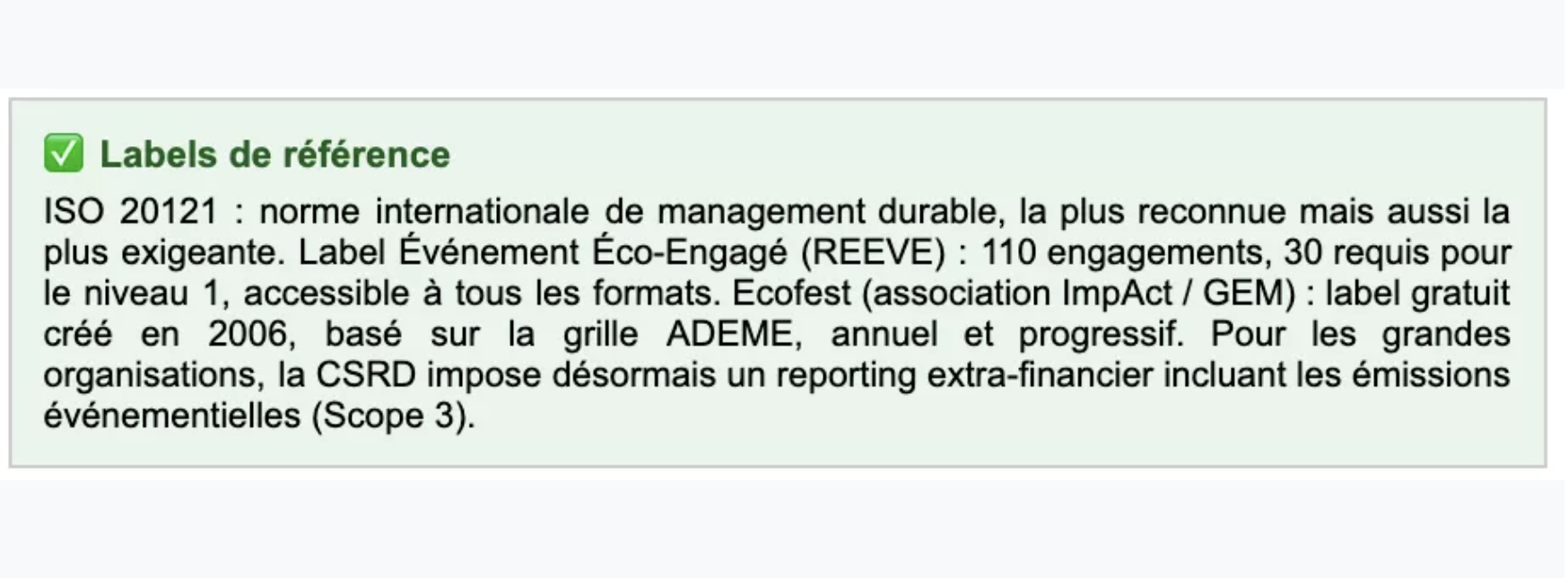
17. Publish the results, including areas for improvement. Consider obtaining recognized certification (ISO 20121, REEVE’s Eco-Committed Event label, Ecofest).
An organization’s environmental commitment is no longer limited to its products: the events it organizes have become platforms for expressing its values, closely scrutinized by participants, partners, and the media. Two key factors are driving this transformation.
On the one hand, there are the expectations of customers and employees. According to a NielsenIQ survey (2023), 72% of Europeans say they are willing to pay more for sustainable and eco-friendly products—a willingness that also extends to the events they choose to attend. The generation entering the workforce today views environmental commitment as a key factor in choosing an employer, not just a nice-to-have.
On the other hand, there is a tightening regulatory framework. The Climate and Resilience Act (2021) classified greenwashing as a deceptive commercial practice under the Consumer Code. The European Empowering Consumers Directive, which is expected to be transposed in 2026, reinforces these obligations. The CSRD requires large companies to provide detailed non-financial reporting that includes indirect emissions—including those related to events.
Turn a seminar or conference into a showcase for corporate social responsibility
An internal event—such as a management seminar, annual conference, or orientation day—is one of the most powerful ways to put an organization’s environmental commitments into practice. It’s not just talk; it’s an experience that employees themselves go through.
Some practical examples: incorporating an awareness-raising workshop (Fresque de l’événementiel, a tool developed by the REEVE network), displaying real-time event impact metrics on venue screens, partnering with a local organization focused on social integration or urban agriculture, or choosing a third place or a site demonstrating the ecological transition as the event venue. These choices establish a credible voice and serve as a sustainable differentiator in both HR and business contexts.
Post-event communication strategies to implement
After the event, publishing the carbon footprint— even if it’s incomplete or could be improved—is a powerful gesture of transparency. Share key figures (amounts of waste avoided, percentage of participants who traveled by train, proportion of plant-based items on the menus) internally and on social media, produce a summary impact report, and collect feedback from participants.
The key is transparency about actual results, including areas for improvement. A report that acknowledges its limitations (“air travel still accounts for 60% of our carbon footprint and remains our biggest challenge”) is far more credible than polished PR. This is the approach recommended by ADEME in its 2025 anti-greenwashing guide.
Recognizing the warning signs of greenwashing
Greenwashing in the events industry takes many forms. First, there’s exaggerated messaging: highlighting the elimination of plastic water bottles on the front page of a report without mentioning that 300 attendees flew in. Next, there’s the overuse of vague terms like “green event” or “carbon-neutral” without specifying the assumptions or methodologies behind them. The Climate and Resilience Act (2021) already prohibits the use of terms like “carbon-neutral” or “environmentally friendly” without evidence.
Relying solely on carbon offsetting is another common pitfall. Purchasing carbon credits to “offset” emissions without first reducing them is not considered sufficient by ADEME. The order is clear: avoid, reduce, and then offset only as a last resort.
Best practices for credible environmental messaging
A credible environmental message rests on four pillars. First, measurement: you can only communicate about your impact if you’ve quantified it using a recognized method. Second, proportionality: communicate about actions in proportion to their actual reduction in impact. Comprehensive coverage of the footprint: cover the entire scope, not just the most favorable items. Comparison to a baseline: “Compared to the previous edition, we have reduced our emissions by 15%” is far more credible than an absolute figure without a reference point.
Organizing an eco-friendly event is a gradual process, not something that can be perfected overnight. The most successful first edition is one where you’ve conducted an assessment, identified your two or three priority areas, and measured your results—which will serve as a foundation for future progress. Continuous, documented, and transparent improvement is infinitely more credible than an event that claims to be “perfectly green” right from the start.
Beyond the events themselves, related topics deserve the attention of committed organizers: accessibility and inclusion as integral components of a responsible event, automated collection of impact data via event platforms (registration forms that include mode of transportation, post-event satisfaction surveys), and the development of an organization-wide CSR event policy.
Organiser un événement éco-responsable consiste à réduire son impact environnemental à chaque étape : choix du lieu, transports, restauration, gestion des déchets, supports numériques et sélection des prestataires. L'objectif est de limiter l'empreinte carbone tout en proposant une expérience de qualité aux participants.
Parmi les bonnes pratiques figurent la réduction des supports imprimés, l'utilisation d'une billetterie numérique, le choix de fournisseurs locaux, une restauration responsable, le tri des déchets, la limitation des objets promotionnels et la mesure de l'impact environnemental de l'événement afin d'identifier des axes d'amélioration.
Une plateforme comme AppCraft contribue à réduire l'impact environnemental en dématérialisant les inscriptions, les invitations, les badges, les programmes et les communications grâce à son application mobile. Elle permet également de centraliser les informations, de limiter les impressions papier et de faciliter le pilotage d'une démarche événementielle plus durable.