By 2026, organizing an event will no longer be limited to coordinating a few tasks; it will involve managing a comprehensive ecosystem that combines registration, communication, engagement, and data analysis. Given the multitude of tools available, making the right choices has become a strategic imperative. Should you use multiple specialized solutions or opt for an all-in-one event platform? Here’s a clear guide to help you understand your options and effectively structure your event stack.
Today, organizing an event relies on several key technological components. There are typically dedicated tools for each stage: a registration solution to manage attendees, an email marketing tool to send invitations, check-in software for the day of the event, a networking platform to facilitate interactions, and analytics tools to measure performance.
In addition, there are specific solutions tailored to different formats: streaming for digital events, mobile apps for in-person events, and gamification tools to engage participants.
While this variety of tools makes it possible to address specific needs, it quickly complicates the overall organization.
Most event organizers still rely on a combination of several tools. This approach is often due to historical reasons: each need was addressed separately, with new solutions being added over time.
One tool for sign-ups, another for emails, a separate CRM, a survey tool… This “best-of-breed” approach may seem sensible in the short term, since each tool performs well within its own scope.
But it creates a reliance on fragmented systems that do not always communicate with one another and require constant manual intervention to stay in sync.
Using multiple tools quickly leads to inefficiencies. The first drawback is wasted time: data exports, manual imports, checks, corrections… These behind-the-scenes tasks take hours to complete for every event.
The second limitation concerns data reliability. Between imperfect synchronizations and duplicates, it becomes difficult to ensure a clean and consistent database. This directly impacts the quality of communications and the participant experience.
Finally, the proliferation of tools makes collaboration more complicated. Each team works on different interfaces, which slows down decision-making and increases the risk of errors.
Faced with these limitations, more and more organizations are turning to all-in-one event platforms, such as AppCraft. The goal is simple: to centralize all features in a single environment to improve efficiency and visibility.
A centralized solution allows you to manage registrations, communications, the program, networking, and statistics all from a single interface. Data is consolidated, updated in real time, and immediately actionable.
This approach transforms the way events are organized: it shifts from a focus on piecing together tools to a focus on overall management.
Adopting a single platform, such as AppCraft, can significantly reduce the operational burden. Repetitive tasks are automated, data is centralized, and processes are standardized.
The time savings are immediate, but the benefits go beyond that. The quality of execution improves: fewer errors, more consistent communication, and a better experience for participants.
It also serves as a strategic tool. The data collected throughout the event can be used to analyze performance, optimize future editions, and refine segmentation.
AppCraft aligns with this approach to centralization by offering a comprehensive event platform designed to cover the entire lifecycle of an event.
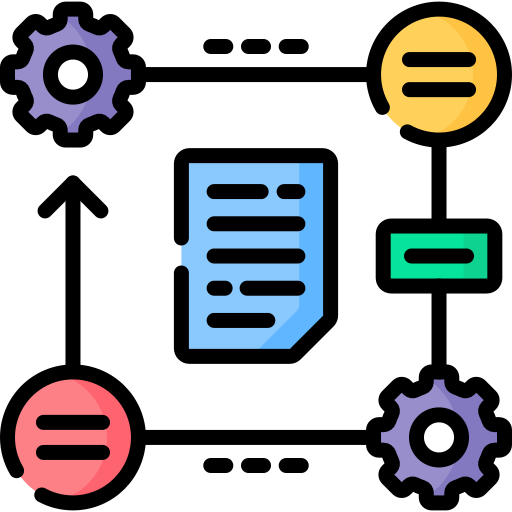
From registration management to on-site coordination, including communications and participant follow-up, everything is integrated into a single tool. Workflows make it possible to automate key tasks and streamline the organizational process.
AppCraft allows teams to focus on what matters most: the quality of the event, the participants’ experience, and achieving their goals.
In 2026, organizers typically use a combination of tools: an event platform to manage registrations and attendees, artificial intelligence solutions to streamline preparation, a mobile app, a check-in system, communication tools, and dashboards to measure the event’s performance.
The choice depends on the type of event, the number of participants, and the objectives. It is advisable to prioritize solutions that centralize key features (registration, communication, check-in, mobile app, reporting) to avoid using multiple tools and performing redundant tasks.
A platform like AppCraft lets you manage the entire event from a single tool: event website, registration forms, attendee management, communications, check-in, mobile app, networking, and reporting. In partnership with waiv.events, it also incorporates artificial intelligence to speed up event creation and preparation.