
Many organizers focus their efforts on the day of the event and neglect two-thirds of their event communication plan: the pre-event phase, which determines attendance rates, and the post-event phase, which builds reputation and reduces costs for the next edition. The reality on the ground is clear: a high-quality event that is poorly promoted beforehand fills only half its capacity; an ordinary event that is well promoted before, during, and after creates a community. This guide provides a three-phase method for implementing consistent and measurable communication, from the opening of registration through the months following the event.
Pre-event communication is structured in three progressive phases, each with a distinct objective and an increasing level of intensity. The obvious metaphor is that of an engine that is started gently before accelerating: starting too strong too early exhausts the audience; saying nothing until 15 days before the event does not give people enough time to make a decision about registering.
Between 90 and 60 days before the event, focus on the launch: go live with a conversion-optimized landing page, announce the date, location, and positioning of the event, and open registration with an early bird offer to reward early registrants and gauge genuine interest. This is also the right time to lay the SEO groundwork for the page: every week it spends online is a point of organic visibility gained.
From 60 days to 30 days before the event, the build-up focuses on content. The program is revealed gradually: speakers are announced in phases, interviews and profiles of speakers are published, and flagship sessions are presented. Each announcement becomes an event in itself, reigniting interest without giving everything away at once. Targeted email campaigns are launched to the existing database; co-promotion partners are reached out to; and press relations are initiated with the first press releases.
The 30-day countdown to launch is the critical phase. The goal is no longer to generate interest but to drive conversions among those who are on the fence. The levers: personalized email follow-ups to non-registrants, paid campaigns (social ads, retargeting), a visible countdown on social media and the landing page, and credible scarcity cues (“X spots remaining,” registration closing on a specific date). Event platforms allow you to automate these follow-ups based on behavior (opening without registration, visiting the page without converting), which avoids blind follow-ups and focuses the pressure on the right contacts at the right time.
Event Day serves two objectives that follow different logics. On the one hand, it aims to boost the event’s visibility in real time among those who are not attending: this is the role of live streams, stories, Reels, and instant posts. On the other hand, it aims to support and enhance the experience of attendees: this is the role of digital signage, real-time program updates, and the Social Wall, which displays participants’ posts on screens throughout the venue.
The official hashtag serves as the key link between these two dimensions. Simple, memorable, and promoted across all platforms on the day of the event (printed or digitalprograms, badges, welcome screens), it aggregates user-generated content (UGC) and amplifies organic reach without requiring additional budget. Creating the right conditions for sharing—photogenic staging, highlights announced in advance, speakers active on social media—increases the volume of UGC without requiring forced engagement.
Dealing with unforeseen circumstances is a blind spot for many teams. A dedicated on-site communications manager, with access to official channels and an emergency communications protocol, is essential for managing speaker delays, room changes, or technical issues in real time without causing panic or an inexplicable radio silence. Participants always prefer imperfect but timely information to prolonged silence followed by a belated explanation.
Finally, the big day is a content creation opportunity not to be overlooked. Professional photos, short behind-the-scenes videos, participant quotes, and excerpts from speeches: by placing social media screens in strategic locations throughout your venue, you’ll engage your participants and showcase the energy of your audience. All of this material will fuel your post-event communications for weeks to come. Capturing this requires planning ahead: a briefed photographer, a defined video capture plan, and key moments identified in advance.
Post-event communication is consistently underutilized. Most teams, exhausted by the big day, send out a thank-you email, post a few photos, and move on to the next project. This is a mistake: it’s the most cost-effective phase in terms of cost per qualified lead, because the audience is engaged, the memory is still fresh, and their willingness to recommend is at its peak.
Within 48 hours: send a personalized thank-you email to participants with access to recordings or a summary, launch a feedback campaign (short form, video testimonial if possible), and post an initial summary of key figures on social media (“X participants, Y speakers, Z sessions”). These actions demonstrate the organization’s professionalism and help cement the event in the collective memory.
In the weeks that follow, the content captured on the day of the event is released in various formats: full replays or selected highlights, session-by-session recap articles, photo compilations, and promotion of the most engaging user-generated content. This is also the time to follow up with non-converting prospects using a contextualized message (“Didn’t make it? Here are the three highlights you won’t want to miss”) and to start teasing the next edition for the most engaged participants.
The strategic goal of this phase is community building. A participant who had a positive experience, receives high-quality content in the weeks that follow, and is given an early heads-up about the next edition becomes an active advocate. They lower the acquisition cost for the next event, recruit through word of mouth, and increase the re-registration rate. A well-managed post-event strategy is the best communication investment for the next cycle.
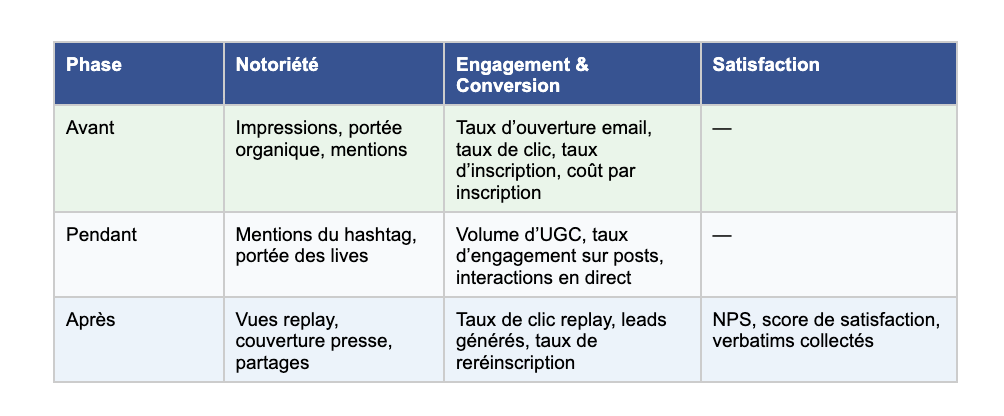
Measuring the effectiveness of event communications requires defining metrics by phase and by dimension before the campaign begins. A KPI that isn’t defined in advance cannot guide decisions as the campaign progresses.
A few guidelines for interpreting data effectively. In the early stages, the conversion rate from invitation to sign-up is the most actionable metric: if it’s low, the problem lies either with the message (an uncompelling value proposition), the targeting (the wrong audience), or the landing page (friction during sign-up). Cost per sign-up, on the other hand, allows you to compare the effectiveness of different channels.
During the event, the volume of UGC and the engagement rate on live posts are the most predictive indicators of the event’s memorability: the more participants share spontaneously, the more the event has created a meaningful experience. After the event, the NPS (Net Promoter Score, i.e., the likelihood that participants will recommend the event on a scale of 0 to 10) is the most predictive indicator of the marketing costs for the next edition: a high NPS directly translates to active word-of-mouth and spontaneous registrations.
The collection and consolidation of these metrics are facilitated by an event platform that centralizes registration data, email campaign statistics, and satisfaction survey results in a single dashboard. Without this centralization, data remains scattered across multiple tools, making it difficult to get a comprehensive view of performance.
AppCraft and Event Communication Management
AppCraft integrates features into its back-office that facilitate the implementation of this three-phase plan: automated email sequences triggered by registration behavior, a real-time Social Wall for the event day, post-event feedback collection, and a centralized dashboard for tracking key KPIs. All without having to juggle a dozen separate tools.
Structuring your communication into three phases isn’t about perfectionism—it’s about efficiency. Teams that implement a before/during/after plan build, event after event, an increasingly seamless process: the audience grows, word of mouth gradually replaces paid advertising, and each event fuels the next.
This guide focuses on the timeline. However, the quality of execution also depends on the preceding steps: defining objectives, segmenting audiences, and selecting the right channels for each target group. We explore these methodological foundations in a separate article—which complements this one—to give event organizers a comprehensive overview of what a structured and effective event communication plan should look like.
Event communication isn't limited to the day of the event. An effective strategy before, during, and after the event helps increase registration numbers, engage participants throughout their experience, and extend the event's impact through replays, satisfaction surveys, and follow-up activities.
An effective strategy consists of three steps: attracting participants before the event through invitations and follow-ups, maintaining their engagement during the event through real-time communications, and then nurturing the relationship after the event with thank-you messages, additional content, and analysis of the results.
A platform like AppCraft centralizes all event communications: invitations, registration confirmations, reminders, notifications, emails, the mobile app, and satisfaction surveys. This allows organizers to manage all their communications from a single tool and provide a seamless experience at every stage of the event.