In a world saturated with advertising messages, event marketing stands out with a radically different approach: rather than interrupting, it invites. Rather than speaking to its audience, it creates the conditions for a shared experience. It is this quality of direct and memorable engagement that makes it one of the most powerful levers in a company’s marketing strategy—and one of the most complex to master. This guide provides the keys to understanding what event marketing is, how to structure it, illustrate it with concrete examples, and measure its impact.
Definition and Challenges for Businesses
Event marketing refers to all marketing activities carried out in connection with an event: organizing a trade show, sponsoring a conference, launching a product live, hosting a webinar, or staging a brand activation. The event is not an end in itself; it is a vehicle for achieving specific marketing objectives: generating leads, building brand awareness, fostering customer loyalty, recruiting talent, or reinforcing a strategic positioning.
Its distinctive feature lies in the nature of the interaction it creates: unlike traditional digital channels (email, advertising, social media), an event delivers a direct, multisensory, and memorable experience. A study cited by Meltwater indicates that 73% of consumers say they are more likely to purchase a product after attending a brand event. This figure illustrates the difference in conversion rates between passive exposure to a message and active participation in an experience.
The key objectives of an event strategy
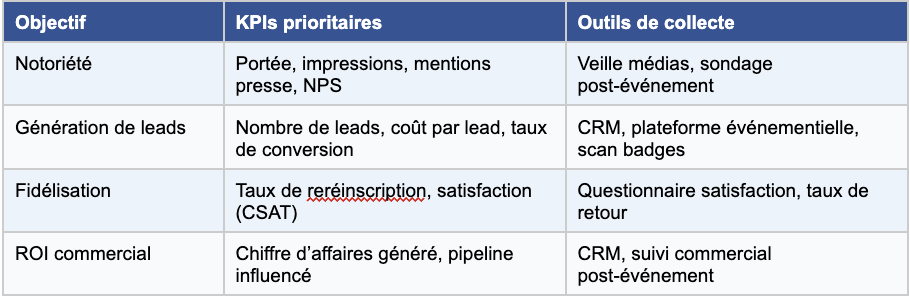
An effective event marketing strategy always begins with defining a primary objective. The most common objectives include generating qualified leads, accelerating the sales pipeline, building loyalty among existing customers, boosting brand awareness, or launching a product or service. The objective is not arbitrary: it determines the event format, the profile of the target audience, the messages to convey, and the metrics to track. An event designed to generate leads is not executed in the same way as an event aimed at retaining existing customers.
In-person, virtual, and hybrid events
The event format is the first strategic decision. In-person events remain the most engaging format: they foster spontaneous interactions, facilitate networking, and create emotional moments that digital formats cannot replicate exactly. Virtual events significantly expand the reachable audience, reduce logistical costs and the carbon footprint, but require a higher level of engagement and interactivity to maintain attention. The hybrid format combines both: an in-person core and a remote component, allowing organizers to reach geographically dispersed audiences without sacrificing the quality of in-person interaction. This is the format that has seen the strongest growth since 2021, and its growth is expected to continue through 2026–2027.
Trade shows, conferences, and brand experiences
Trade shows and conferences are the most traditional formats in B2B event marketing. Their strength lies in bringing together, in one place and at one time, a highly qualified audience that is ready to engage in business discussions. Brand experiences—also known as “brand activations”—follow a different logic: rather than simply informing, they aim to evoke an emotion, create a memory, and foster a positive association with the brand. These formats are preferred for product launches, high-end customer engagement initiatives, or brand image campaigns.
Sponsored events and on-the-ground activations
The company isn’t always the organizer: it may also participate as a sponsor or partner in a third-party event. Event sponsorship provides access to a pre-qualified audience without having to bear the full cost of organization, provided that sufficient visibility and activation rights are negotiated. On-site activations are physical installations deployed in public spaces or at events: booths, product demonstrations, games, and interactive installations. Their value lies in reaching a broad, casual audience by creating a memorable moment of engagement that is often shared on social media.
Define your target audience and key messages
Audience segmentation is the foundation of any serious event strategy. A single event can bring together several different types of attendees: prospects to convert, customers to retain, partners to engage, and the press to win over. Each group expects a tailored message and experience. Defining event personas—who are they? What are their expectations? What will motivate them to take action?—enables you to design a program, communications, and participant journey that are truly differentiated by group.
The event’s key message—the core value proposition that attendees will take away—must be defined first and foremost. All content, speakers, workshops, and communications stem from this. Without this central theme, the event risks feeling disjointed and failing to leave a lasting impression.
Choosing the right format and distribution channels
The choice of format depends on the target audience, budget, geographic location, and objective. An annual conference positions the company as an industry leader; a monthly webinar nurtures long-term business relationships; a prospect lunch creates an informal setting conducive to accelerating the sales cycle. Distribution channels—email, social media, press relations, co-promotion partnerships, SEO—must be activated in a complementary manner, following a progressive logic: brand awareness, then conversion, then customer retention. The event management platform is the tool that centralizes registrations, communications, and data, and automates communication sequences before, during, and after the event.
Real-world examples from major international brands
Salesforce Dreamforce is one of the most frequently cited tech conferences: each edition brings together tens of thousands of attendees in San Francisco and hundreds of thousands online. The event has become a marketing asset in its own right: it accelerates the sales cycle for Salesforce sales reps, generates massive media coverage, and positions the company as a category leader. Apple, for its part, has elevated its Keynotes to cultural events: they are no longer just product launches but moments of collective excitement, broadcast live to millions of viewers, that build anticipation and desire well in advance of the product’s release.
These examples illustrate a fundamental principle: brands that excel at event marketing do not treat their events as isolated incidents, but as recurring strategic assets that strengthen their positioning year after year.
Examples tailored to small and medium-sized businesses and local stakeholders
Event marketing isn’t just for big brands. A consulting firm that hosts a monthly breakfast for about a dozen HR directors in its region creates a high-value-added networking opportunity that bolsters its credibility and accelerates business discussions without any direct sales pressure. An industrial SME that invites its key clients to an open house showcasing a new technical innovation combines product demonstrations, customer loyalty building, and influencer engagement all in a single event.
In both cases, the key to success is the same: a format tailored to the target audience, content that provides real value (information, networking, expertise), and a structured follow-up process in the days following the event. The number of participants matters less than the quality of the targeting and the quality of the follow-up.
Key performance indicators (KPIs) to monitor
Event KPIs are not universal: they depend directly on the objective set in advance. An event designed to generate leads will be evaluated based on the number of qualified leads collected, the cost per lead, and their conversion rate in the weeks that follow. An awareness-building event will be evaluated based on media reach, the volume of social media mentions, and changes in brand perception as measured by surveys.
One metric deserves special attention: the actual attendance rate relative to the number of registrants. A significant gap between registrations and actual attendance often points to an issue with messaging, timing, or follow-up. The post-event NPS (Net Promoter Score) is an excellent indicator of the perceived quality of the experience and the likelihood of re-registration or recommendation.
Tools and methods for calculating return on investment
Event ROI is calculated using the standard formula: (value generated − total event cost) / total cost × 100. The challenge lies in defining “value generated,” which is not limited to the revenue directly generated by the event. It also includes the influenced sales pipeline, the value of activated relationships (partnerships, influencers), and the value of the data collected. This broader perspective is essential to avoid systematically underestimating events whose commercial impact materializes 3 or 6 months later.
Event management platforms play a key role in this regard: by centralizing data on registration, attendance, on-site engagement, and post-event satisfaction—and by linking it to the sales CRM—they enable organizations to track a participant’s entire journey, from invitation to conversion. Without this traceability, ROI remains an estimate; with it, it becomes a key factor in decision-making.
The Rise of Hybrid Events and Data
Hybrid events are no longer a necessity born of the health crisis; they have become a deliberate strategy for expanding the audience. Combining a strong in-person core with a well-executed digital broadcast makes it possible to reach international audiences, enrich content with remote speakers, and extend the event’s lifespan beyond the day of the event with replays and derivative content. At the same time, data is playing an increasingly important role in decision-making: organizations that systematically measure the impact of their events are gradually expanding their event budgets by justifying them with hard data.
Personalization and Community Engagement
Participants are increasingly turning away from standardized events: they want experiences tailored to their profile, interests, and level of maturity. Personalization extends to the program (sessions recommended based on profile), communications (invitation emails tailored to the segment), and even the badge and on-site welcome. This personalization is made possible by event platforms that centralize participant data and enable automatic segmentation rules.
The other key trend is the use of events as a tool for community building. Rather than organizing one-off events, the most forward-thinking brands create recurring event calendars—annual conferences, monthly webinars, quarterly breakfasts—that foster an active community throughout the year. This approach reduces the cost of acquiring participants with each edition and builds a lasting reputational asset.
📌 AppCraft and Event Marketing
AppCraft supports marketing teams in implementing their event strategies: registration and invitation management, audience segmentation, automated multichannel communication, on-site check-in, attendance data collection, and performance dashboards. The goal: to reduce the operational burden so teams can focus their energy on what creates value—the quality of the content and the attendee experience.
Event marketing is one of the most demanding forms of marketing—and one of the most rewarding when done right. It requires time, resources, and expertise; in return, it yields high-quality leads, actionable data, and memorable experiences that other channels simply cannot deliver.
To take things a step further, there are several topics worth exploring: developing a cohesive annual event calendar, integrating event tools into the overall marketing stack (CRM, marketing automation), and the growing role of AI in personalizing the attendee experience. These are all areas we will continue to explore to help organizers get the most out of their event investments.
Event marketing involves using events to promote a brand, build brand awareness, generate leads, or foster customer loyalty. It can take the form of trade shows, conferences, seminars, product launches, webinars, or internal events, with the goal of creating an engaging and memorable experience.
An effective event marketing strategy is based on clear objectives, a thorough understanding of the target audience, communication before, during, and after the event, and an analysis of the results. Tracking registrations, measuring participant engagement, and calculating ROI are essential for improving future events.
A platform like AppCraft allows you to centralize all marketing activities related to an event: creating the event website, managing registrations, email campaigns, mobile apps, networking, satisfaction surveys, and dashboards. This gives teams a comprehensive overview to manage their events and measure their performance.