
Quizzes are one of the most effective ways to engage an audience at a professional event, yet they are also among the most time-consuming to create. Coming up with the right questions, tailoring them to the audience, and adapting them to different themes—these are all tasks that, until now, required considerable time and expertise. Artificial intelligence is changing the game. In just a few seconds, an AI-powered quiz generator produces structured, relevant content that’s ready to be customized. For organizers, this is a real opportunity to offer more activities, more often, without overburdening their teams.
Event quizzes: a powerful but time-consuming tool for driving engagement
In the world of professional events, quizzes hold a special place. They break up the monotonous flow of lectures, engage every participant—regardless of where they’re sitting in the room—and generate useful data: who answers, how they answer, and how quickly.
However, creating a good quiz takes time. You have to define the theme, research reliable information, write clear questions with credible answers (including distractors), calibrate the difficulty, and validate the content with stakeholders. To a one-day or a corporate social responsibility conference, this work can take several hours. Not to mention the challenge of adapting the difficulty level depending on whether you’re addressing industry experts, new employees, or key account clients.
It is precisely at this bottleneck that AI is most relevant.
Automating Content Creation: How an AI Quiz Generator Works
The concept is simple: the organizer enters a topic—such as "cybersecurity for non-technical staff," "our group's CSR values," or "our company's history"—and the AI automatically generates a set of questions along with their answers. In just a few seconds, a structured quiz is available, ready to be reviewed and adjusted.
What sets the quiz generators built into an event platform from general-purpose tools is the context. An AI system fed with event data (program, speakers, target audience) produces content that is far more relevant than a generic prompt. It can generate questions about a specific speaker, a product launched during the event, or the conclusions of a previous session.
Human validation remains essential, and that is by design. The AI generates, the organizer validates and adjusts. This division of roles is the right one: it brings out the best in both. No question goes into production without being reviewed, and that is how quality is maintained.
From operational gains to event performance
The most immediate benefit is the reduction in preparation time. What used to take several hours of collaborative work can now be done in just a few minutes. But the impact goes beyond simply saving time: it has transformed both the frequency and variety of activities.
An organizer who previously had to choose between spending time on a quiz or on other aspects of preparation can now do both. The ability to produce more content, faster, translates into events with a better flow, featuring more frequent and better-targeted interactive moments. This enhances the overall quality of the event’s facilitation without placing an additional burden on the team.
Before, during, and after: key moments for making the most of the quiz
The quiz isn't limited to the venue. When used effectively, it supports the event throughout its entire lifecycle.
In the run-up to the event, it serves as a teaser: a series of questions sent to participants a few days before the event builds anticipation, sparks curiosity, and prepares attendees for the topics that will be discussed. It’s also a way to engage the audience even before the big day, fostering a sense of participation right from the invitation.
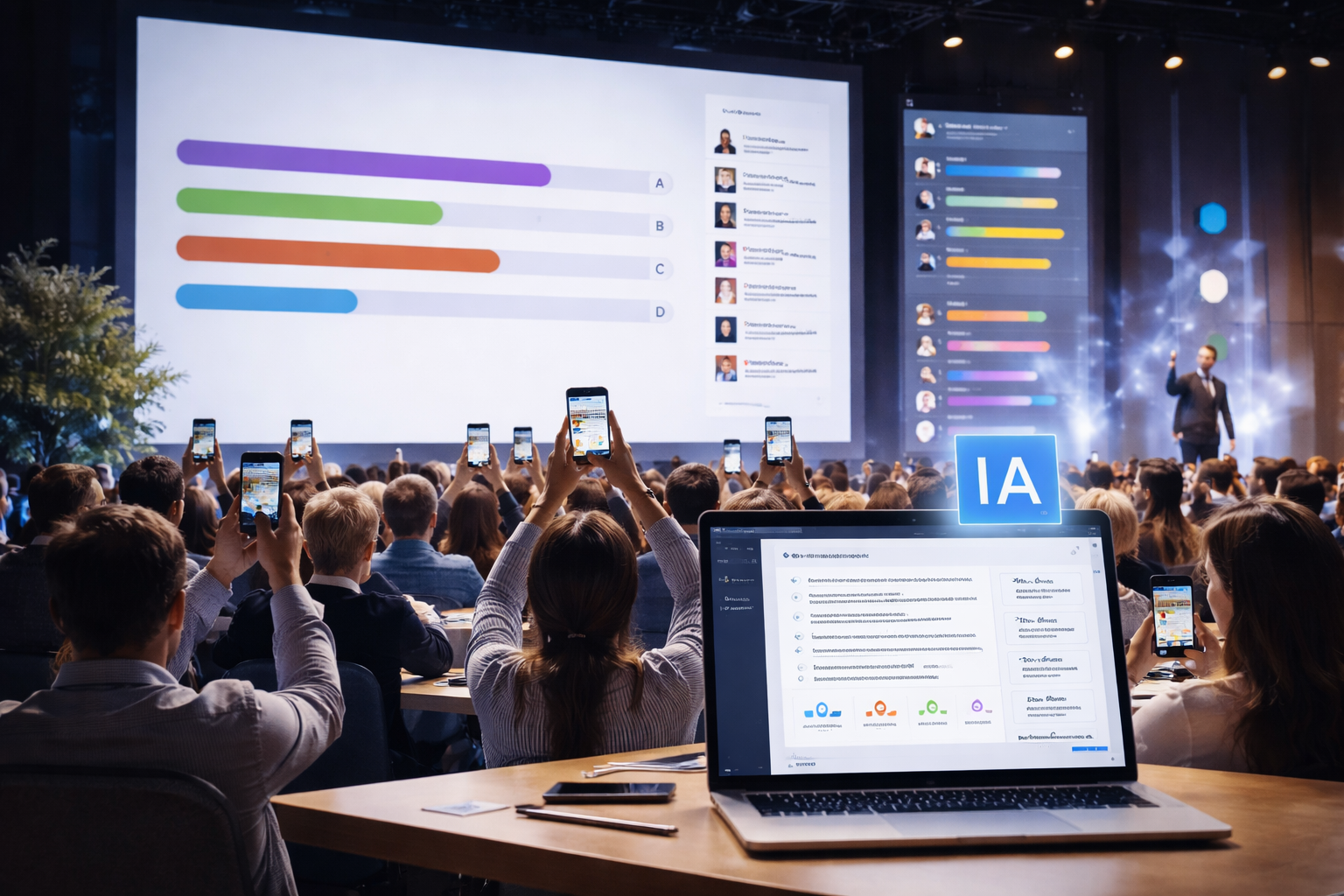
During the event, the quiz serves as a way to keep things moving. Scheduled between sessions, it refocuses attention, breaks the passive listening dynamic, and encourages each participant to engage actively. When done in teams, it fosters healthy competition and informal interactions among people who haven’t met yet.
After the event, the quiz can serve an educational purpose: testing participants’ retention of key messages, gauging what made the biggest impression, or assessing participants’ engagement based on their results. This data, incorporated into post-event reporting, enhances the analysis of the event’s actual impact.
Personalization and relevance: tailoring quizzes to your specific needs
A generic quiz works. A customized quiz leaves a lasting impression. The difference lies in the ability to anchor the questions within the specific context of the event, the company, or the industry.
An educational quiz on the group’s CSR policy, a marketing quiz centered on a product launch, or a corporate culture quiz designed to foster a sense of belonging: each objective calls for a different format and tone. AI makes it possible to quickly adapt this content, produce multiple versions tailored to specific sessions, and adjust the difficulty level based on the audience.
Segmentation is key: the questions that are relevant to internal employees are not the same as those for customers at a trade show or partners at a conference. A platform that understands participant profiles can generate different versions of the same quiz, tailored to each segment, without increasing the workload.
Real-world use cases for event organizers
For a seminar or corporate conference, a quiz is a natural fit for team-building activities. It offers a fun way to reinforce key messages, assess understanding of an action plan, or facilitate a plenary session on the year’s priorities. The collective experience strengthens group dynamics.
At a trade show or B2B event, a quiz hosted at a booth serves as a lead generation tool. It attracts visitors, creates an engaging point of contact, and allows you to gauge interest in real time based on the responses provided. The data collected is directly fed into the sales follow-up process.
For internal events, quizzes are an effective way to convey company culture and knowledge. They help participants retain information that might otherwise be difficult to remember if presented in a traditional format. Even a mild competitive element helps stimulate attention and engagement.
Gamification as the standard for modern events
Participants' expectations have changed. A purely top-down format (speaker, slides, silent audience) is no longer enough to sustain engagement over time. Participants want to interact, contribute, and take an active role in their experience. Gamification meets this need by transforming potentially passive moments into participatory activities.
Quizzes are the natural starting point for event gamification: they’re easy to understand, quick to get the hang of, and require no special equipment or prior training. They can be gradually enhanced (with real-time leaderboards, participation badges, and team challenges) to create a more comprehensive experience.
It also works in tandem with other interactive formats: polls gather opinions, votes prioritize topics, and challenges engage teams. Together, these tools form the building blocks of modern event facilitation, with the quiz often serving as the first step.
Streamline your animations without overburdening your teams
One of the barriers to the widespread adoption of interactive activities at professional events is the workload they place on teams. Designing, testing, integrating, and facilitating: each quiz requires resources. AI helps overcome this barrier by handling the creation phase, which is the most time-consuming part of the process.
The direct result is a reduction in reliance on specialized internal resources. An event team no longer needs a subject matter expert on hand to draft questions on a technical topic: the AI generates a first draft that the expert can review and approve in just a few minutes. This shift in role (from writer to reviewer) represents a significant operational gain.
For organizations that manage multiple events each year, the ability to roll out quizzes on a large scale—while ensuring consistent quality—transforms the very nature of event engagement. It becomes a standard that is reproducible, scalable, and measurable, rather than an exception reserved for events with the most resources.
With this in mind, AppCraft has integrated AI-powered quiz generation into its event platform: not just as another feature, but as a key component of the engagement strategy, linked to event data and participant profiles.
AI doesn't replace creativity or a knack for animation; it unlocks them. By taking over the production of repetitive, time-consuming content, it allows teams to focus on what really matters: designing the experience, engaging with participants, and ensuring the message is relevant.
The AI-generated quiz is just one example of what artificial intelligence can do in the events industry. The same principles apply to drafting communications, customizing the program, and analyzing post-event feedback. These are all areas we will continue to explore in future articles to help organizers create events that are more engaging, more effective, and easier to produce.
Le format dépend de ce que l’on veut obtenir. Pour un séminaire ou une convention corporate, un quiz sur les messages stratégiques ou le plan d’action de l’année renforce la cohésion et vérifie la compréhension. Sur un salon ou un événement B2B, un quiz déployé sur un stand attire les visiteurs et permet de qualifier leur intérêt selon leurs réponses, ce qui alimente le suivi commercial. Pour un événement interne, un quiz de culture d’entreprise ou un quiz pédagogique sur la politique RSE aide à ancrer les connaissances. Avec AppCraft, l’IA peut générer plusieurs versions d’un même quiz, adaptées à chaque profil de participants.
À chaque étape du cycle, et pas seulement en salle. Quelques jours avant l’événement, une série de questions envoyées aux participants crée de l’anticipation et les prépare aux thématiques abordées. Pendant l’événement, un quiz placé entre deux sessions relance l’attention et casse la posture d’écoute passive. En équipes, il favorise aussi les échanges entre personnes qui ne se connaissent pas. Après l’événement, il permet de tester la rétention des messages clés et de mesurer l’engagement de chacun. Dans AppCraft, ces résultats sont intégrés aux statistiques de l’événement pour analyser l’impact réel de la journée.
Non : la validation humaine reste indispensable, et c’est voulu. L’IA produit en quelques secondes une première version structurée, mais aucune question ne doit être diffusée sans relecture. Ce contrôle garantit l’exactitude des réponses, la pertinence des leurres et un niveau de difficulté adapté au public. Le rôle de l’expert métier change : il passe de rédacteur à relecteur, ce qui lui prend quelques minutes au lieu de plusieurs heures. Un générateur intégré à la plateforme, comme celui d’AppCraft, part en plus des données de l’événement (programme, intervenants, public), ce qui produit des questions plus pertinentes qu’un outil généraliste.